Why cash flow is important to small business
Most small businesses that fail run out of cash, not ideas. Here is what cash flow is, how to forecast it, the mistakes to avoid, and how getting paid faster keeps money moving through your business.
Why is cash flow so important for a small business?
Short answer: Because running out of cash, not running out of profit, is what closes most small businesses. A business can be profitable on paper and still be unable to pay its bills if the money is tied up in unpaid invoices. Understanding, forecasting and protecting your cash flow is what keeps the doors open.
Running a small business is no easy feat. Past the appeal of setting your own schedule and being your own boss sits a harder reality:
Poor management or a lack of foresight may play a part, but cash flow is the problem that comes up again and again. The good news is that it can be planned for.
What is cash flow?
Cash flow measures the movement of money in and out of your business. It sounds simple, but it is a concept many small business owners overlook.
Cash flow is not the same as profit
Profit and cash flow are related, but they are not the same. Cash flow reflects the money actually in your bank account, so your business can turn a profit and still have no cash. If you are selling products but your expenses are higher than the income you have actually received, your cash flow is negative.
Accounts payable and accounts receivable
- Accounts payable is a liability account that tracks money leaving your business, such as payroll, business expenses and loan repayments.
- Accounts receivable is an asset account that tracks money coming into your business: what customers owe you for the goods and services you provide.
Here is where the difference shows. Your business could make a profit of $30,000 in a month but see only $10,000 of it as cash, because the rest is still sitting in accounts receivable. Both accounts are essential for balancing your books and understanding how profitable your business really is.
How do I forecast cash flow?
Forecasting your cash flow prepares you for both planned and unexpected expenses, and helps you spend efficiently. It matters even more for seasonal businesses, which see an influx of cash during the busy season and little during the rest of the year.
Run a cash flow report
The best way to track cash flow is a cash flow report. It shows cash received and cash paid, and your business's cash position at the end of each month. You will see, for example, what happens to your cash when a customer pays a bill, when you pay a supplier, or when you hire an independent contractor.
For clearer tracking, you can split the report into three parts:
| Segment | What it covers | Examples |
|---|---|---|
| Operating flow | Income and spending from your day-to-day trading (net income) | Buying merchandise; revenue from your products and services |
| Investing flow | Investments used repeatedly to increase efficiency or profitability | Buying commercial property or equipment |
| Financing flow | Transactions around dividends, debt or equity | Loans, repayments, dividends |
Five things a forecast helps you do
1. Fund new staff, products or a new business. Starting or launching something new takes cash, from new equipment to a website or a deposit on office space. Do not be alarmed if more cash goes out than comes in at first. You will still need to cover these costs and keep capital in reserve for when you open your doors. Consider investing some of your own money to cover start-up costs, and explore financing options such as a business loan, a line of credit or a small business grant.
2. Keep track of overdue payments. Consistent late payers can hold your business back. A forecast shows the impact on your bottom line and gives you time to alert clients, and it highlights the need for effective credit control and timely payment strategies.
3. Prevent overspending. Every business has time-sensitive revenue goals. Forecasting shows when, and whether, you will reach them, and breaks your budget down by the movement of cash in and out. You will see whether you are over or under budget, and your future budgets will become more accurate.
4. Plan for seasonal trends and cash gaps. Seeing cash gaps in advance lets you put a payment plan in place. Set aside enough cash from peak periods to cover operating expenses in slower seasons, and consider an extra buffer for unexpected costs. Create a calendar of your operating expenses, with every recurring payment and its due date.
5. Budget for tax payments. Tax payments always seem to arrive sooner than expected. Many business owners do not realise they can pay the ATO by credit card through B2Bpay, which keeps money in the bank for longer. You hold on to your cash during your card's interest-free period, at no interest cost as long as you pay your card bill on time, and you earn your card's full reward points. The ATO plans to stop accepting credit cards directly after 30 June 2027, but B2Bpay pays the ATO by bank transfer on your behalf, so this route continues. Read paying the ATO by credit card.
What are the most common cash flow mistakes?
Overspending
Impulse spending in the start-up phase is easy to fall into. It takes money to make money, but not every expense is necessary. Weigh the cost and benefit of every expense, set a realistic budget and stick to it. Keep checking how each purchase pushes back your break-even point: the point at which your business earns back the cost of your initial spending.
Not getting paid quickly enough
Delayed payments and unpaid invoices can quickly drain a small business's cash. Businesses without firm late-payment penalties and collection policies are the most exposed. Asking customers to pay can feel risky when you are new, but stay diligent and consistent: once clients know you will follow up the moment a payment is late, they are less likely to delay. Good policies often include a percentage late fee after about 5 days, or stopping work once an invoice is 30 days overdue (for service businesses).
Overestimating future sales
Starting a business takes confidence and optimism, but cash flow planning needs realism. Once you have been trading for a few years, base your forecasts on past numbers and evidence, using your own revenue history or figures from other businesses in your industry to spot trends and allow for variation across periods such as the holidays. In your first few years, consider working with a mentor from your industry who can help you project sales from their own experience.
Not having enough cash on hand
Unexpected costs are part of running a business. They need not be make-or-break if you have a cushion of savings, but a business running on a zero or negative balance can be badly hurt by one low month. Aim to keep a balance equal to at least two months of operating expenses, so the reserve is there if you need it.
How does B2Bpay help with cash flow?
B2Bpay tackles one of the most common cash flow problems: getting paid. It helps on both sides of your business.
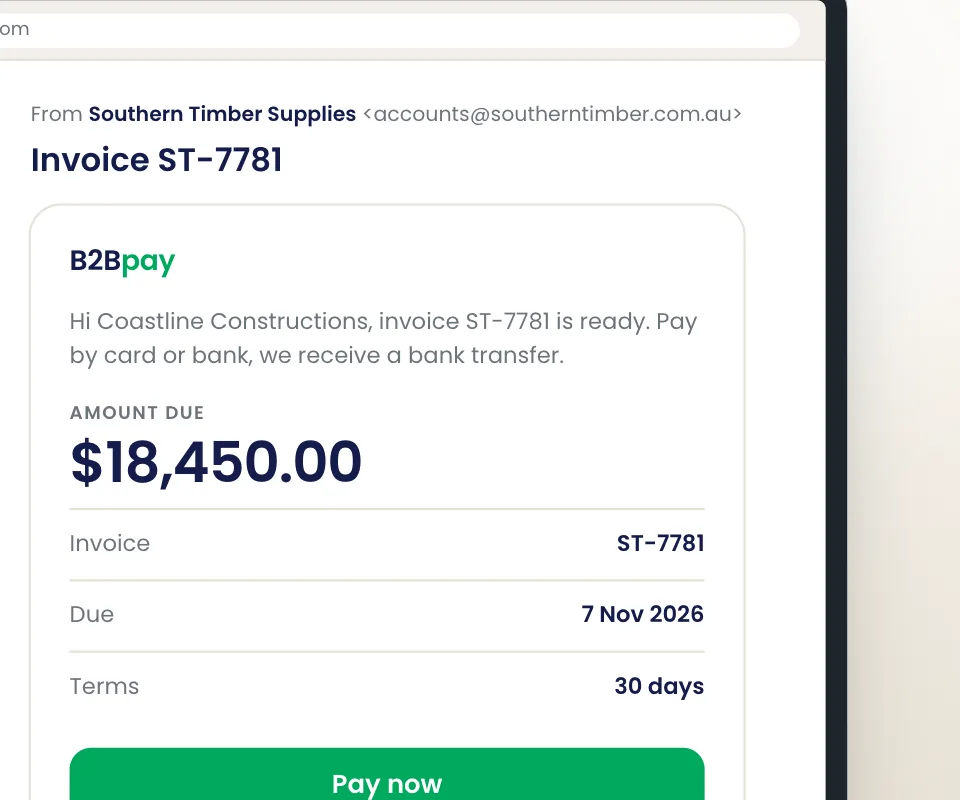
Get paid faster
- More ways to pay. Accept all major credit cards, and bank account payments too, so customers have fewer reasons to pay late.
- A payment link on every invoice. Add a B2Bpay payment link or button to your invoice template so paying you is quick and simple.
- Funds within 3 business days. Payments are sent to you by EFT or BPAY within 3 business days.
- Qantas Points for getting paid. Earn Qantas Points on eligible payments you make and receive with B2Bpay, which can help offset business travel and accommodation costs. See earn Qantas Points.
Help your customers' cash flow too
When your customers pay you by card, they can use their card's interest-free period of up to 55 days. The same applies when you pay your own bills through B2Bpay. Read up to 55 days interest-free.
Can I connect my accounting software?
Yes. B2Bpay connects to Xero, MYOB and QuickBooks. Once connected, the payments you make and receive are recorded automatically in one place, with no manual entry.
- Paying bills. See your pending bills in B2Bpay and pay them in one click, so you stay organised and avoid late fees. Your accounting software is updated and reconciled for you.
- Getting paid. B2Bpay sets you up with a unique, branded payment page. Customers click "Pay Now" on your invoice to reach it, and every payment is recorded in your accounting software.
See B2Bpay with Xero and pay bills from Xero, MYOB or QuickBooks.
The bottom line
Cash flow is one of the most difficult and daunting parts of owning a small business. With careful planning and spending, you will be ready for both the expected and the unexpected.
B2Bpay helps you keep cash flowing by accepting card payments and getting paid faster. There is no equipment to buy and no monthly fee is stated; a card payment fee applies to each payment received, and you choose whether to absorb it or show it to your customer (see pricing for receiving payments). Your customers get an easy way to pay immediately, and you earn Qantas Points just for getting paid.
Become a B2Bpay biller and let B2Bpay take the hassle out of chasing payments, so you can focus on what you do best: looking after your customers and growing your business. To find out more, get in touch or speak to a specialist on 1300 205 575.
1 According to the Australian Bureau of Statistics: abs.gov.au. This article is general information, not financial advice; speak to your accountant about your business.
Frequently asked questions
What is the difference between cash flow and profit?
Profit is what is left after expenses on paper; cash flow is the money actually moving in and out of your bank account. A business can make a $30,000 profit in a month but see only $10,000 in cash if the rest is still owed by customers in accounts receivable.
What is a cash flow report?
A report showing cash received and cash paid, and your cash position at the end of each month. It is often split into operating flow (day-to-day trading), investing flow (property and equipment) and financing flow (dividends, debt and equity).
How much cash should a small business keep on hand?
Aim for a balance equal to at least two months of operating expenses. That reserve lets you absorb unexpected costs or a slow month without putting the business at risk.
How can I get my invoices paid faster?
Make paying easy and be consistent about collections. Add a B2Bpay payment link to your invoices so customers can pay by card or bank account online, and set clear late-payment policies, such as a percentage late fee after about 5 days. See accept card payments.
Can I pay the ATO by credit card to help cash flow?
Yes, through B2Bpay. B2Bpay pays the ATO by bank transfer on your behalf, so your cash stays in the bank during your card's interest-free period and you earn your card's reward points. See paying the ATO by credit card.
Get paid faster with B2Bpay
Add a payment link to your invoices and let customers pay by card or bank account. Funds arrive within 3 business days.